
At the largest industrial forum in the Persian Gulf, the CEO of an Abu Dhabi-based satellite company explained how they are building an AI-powered satellite constellation that already has the French government as its anchor client. This case challenges traditional technology transfer models.
For the first time, an emerging Middle Eastern hub is providing strategic space capabilities to European governments, rather than simply being a user or buyer of such technology. The vehicle for this change is Altair , the firstconstellation of satellites with artificial intelligencedeveloped in the region, and the company behind it is Orbitworks , based in Abu Dhabi.
This media outlet spoke with Hamdullah Mohib , interim CEO of Orbitworks and CEO of Marlan Space —a startup dedicated to the development of commercial satellite capabilities—, within the framework of the fifth edition of Make it in the Emirates ( MIITE ),the region’s flagship industrial and manufacturing investment forum, which took place between May 2 and 7.
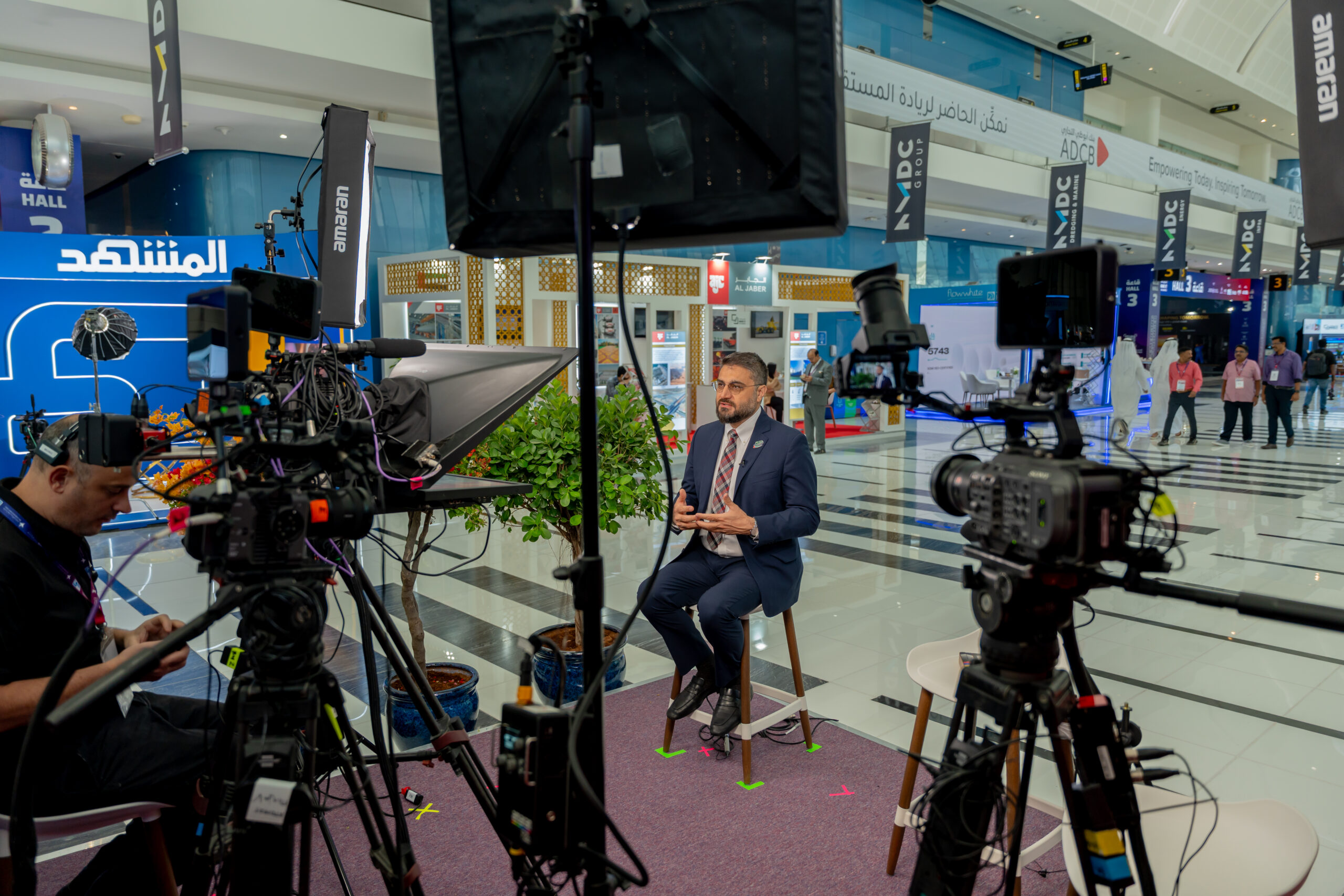
The event, which annually brings together authorities and executives from around the world interested in trading and producing from this global platform, acquired significant strategic importance this year: it became the first major economic event in the region since the outbreak of the conflict in the Middle East. The message is clear: while part of the region is experiencing a crisis, the business conglomerate is accelerating its efforts to become the gateway to that market and the benchmark for economic recovery.and leadership in AI processes applied to the value chain.
A historic role reversal
Altair is composed of ten multi-sensor satellites —optical, infrared, thermal and radio frequency— with onboard AI processing, powered by Nvidia GPUs.Its architecture allows data to be analyzed at the same time it is captured and actionable alerts to be sent without depending on ground processing lines.The time between taking an image and generating useful intelligence can be reduced from six hours to just a few minutes.
“From the moment the picture is takenuntil obtaining the analytical information, in our case with a satellite or Earth observation constellation,It can take six hours. And sometimes, if it’s a disaster or a situation that requiresan immediate response; six hours may be too long.”That’s why being able to process on the satellite itself and deliver results quickly, in minutes, is very important, particularly in critical circumstances,” Mohib explained.
A European government—considered the most sophisticated space operator in Europe, according to Mohib—has already signed on as the anchor client for the constellation. This is not a single agreement: it comprises three separate contracts that include the integration of a radar, the addition of a camera, and the use of capacity within the Altair constellation.
“For a client of that magnitude to be using services built in the Emirates, from a constellation manufactured here, is a significant endorsement. It proves the thesis that we can build and operate from the UAE and compete globally with any company anywhere in the world,” he noted.
Mohib came to this role with a background that surprises those who discover it for the first time. Before holding positions in the public sector, he studied computer systems engineering, and his first job was at Intel, when the company was one of the three largest in the world. “Coming back to this feels like coming home,” he admitted.
That technical foundation, combined with years of management experience in highly uncertain environments, defines his leadership style. When asked about the most valuable principle he brought from his previous experience to the startup world, his answer was direct: “Two: patience and the ability to operate in ambiguity . I believe that both the government and the private sector have that characteristic, especially when you operate in an area like ours.”You have to be able to deal with a lot of ambiguity. There’s very little clarity, and I think that’s a key skill that overlaps in both worlds.”
Reduce risks in unfamiliar territory
Building a space company in an ecosystem with no prior experience involves simultaneously managing technological and organizational risks. Orbitworks ‘ strategy was clear:rely on proven technologies to avoid accumulating uncertainties on multiple fronts at the same time.
“We sought to ensure we relied on technologies that were truly proven. In this way, we didn’t assume technological risks at the same time as organizational risks. We reduced the technological risk and then mitigated the organizational risk as much as possible to guarantee that we have the product we need,” Mohib explained.
The human factor is central to this scheme. “Finding the right people is the most important thing. I was lucky to find people as committed to the mission as I am,” he said.
One of the most compelling arguments Mohib made during the conversation was that of space sovereignty as an economic necessity, not just a military one.Our dependence on space is going to increase exponentially.We already use space assets to navigate to certain places, to watch television, to access the internet in remote areas and sometimes even within urban areas. To communicate. Governments use them for a lot of different areas, from security to disaster management. The private sector uses them. Insurance companies use them to assess and mitigate losses. We use them for weather forecasting,” he listed.
“And this is going to grow much more as autonomy becomes the primary driver of mobility. We’re going to need many more space services, and if as a nation you don’t have the capacity to meet those needs, your dependence will grow. And more importantly, that puts the business and operations at risk because, as dependencies grow, if you can’t replace them… satellites can be damaged, just like any other vehicle; accidents happen in space. How quickly do you replace them so the business can continue? That’s going to be critical for operations.”
In his view, space sovereignty “goes far beyond security. It’s about improving lives and being able to be competitive on a commercial scale.”
Specific applications: from logistics to mineral exploration
The applications that Orbitworks is developing cover very diverse sectors.Monitoring maritime supply chains, traceability from the origin of resources to the market, emergency response, and impact assessment of development projectsIn Africa and South America are some of the cases that Mohib mentioned.
It was precisely during Make it in the Emirates 2026, on May 6, that Orbitworks signed a strategic agreement with IRH Technology —a subsidiary of Abu Dhabi-based International Resources Holding—to develop a joint use case in mineral exploration. IRH Technology’s platform, which has already processed more than5.5 million square kilometers across more than 2,200 global projectsIt will be integrated with Earth observation data from the Altair constellation to identify and prioritize high-potential mineral deposits using artificial intelligence.
A model for economies with space ambitions
The case of Orbitworks is particularly relevant for countries that, while not traditional space powers, have aspirations in the sector: Turkey , Brazil , Singapore , Kazakhstan , South Africa or even Argentina , among others.
“We have access to the same talent, the same technology, and the same capital as any other company. These three elements give us the opportunity to compete globally,” Mohib stated. He added that success didn’t come easily: “We had support from the government and the private sector. But we didn’t know if it would be easy to recruit people to come and work in this area, or if, if we built it, people would buy it.”
The recipe he proposes for other countries combines three ingredients: ambition, focus, and risk tolerance. “It can’t be done without ambition and the ability to take risks. There’s a lot of uncertainty because we don’t know what the challenges will be. It’s a new area.”
Regarding the public-private partnership model , Mohib was direct:The private sector can operate at a much faster pace than governments. The right combination—government providing the strategic vision, the private sector executing those agendas—leads to success. I would even say to a successful industrial revolution.”
Orbitworks’ first satellite is scheduled for launch in the fourth quarter of this year . The production facility in KEZAD , Abu Dhabi, is already built and operational.
The five-year vision is clear: “I would like Orbitworks to be one of the global competitors in space assets. That when companies providing services are named, Orbitworks is among them without hesitation.”
For now, the numbers support that aspiration: within its first year of operation, the company has already closed deals with some of the world’s most sophisticated clients. The traditional script for technology transfer—from North to South, from developed to emerging economies—is being rewritten from Abu Dhabi, satellite to satellite.