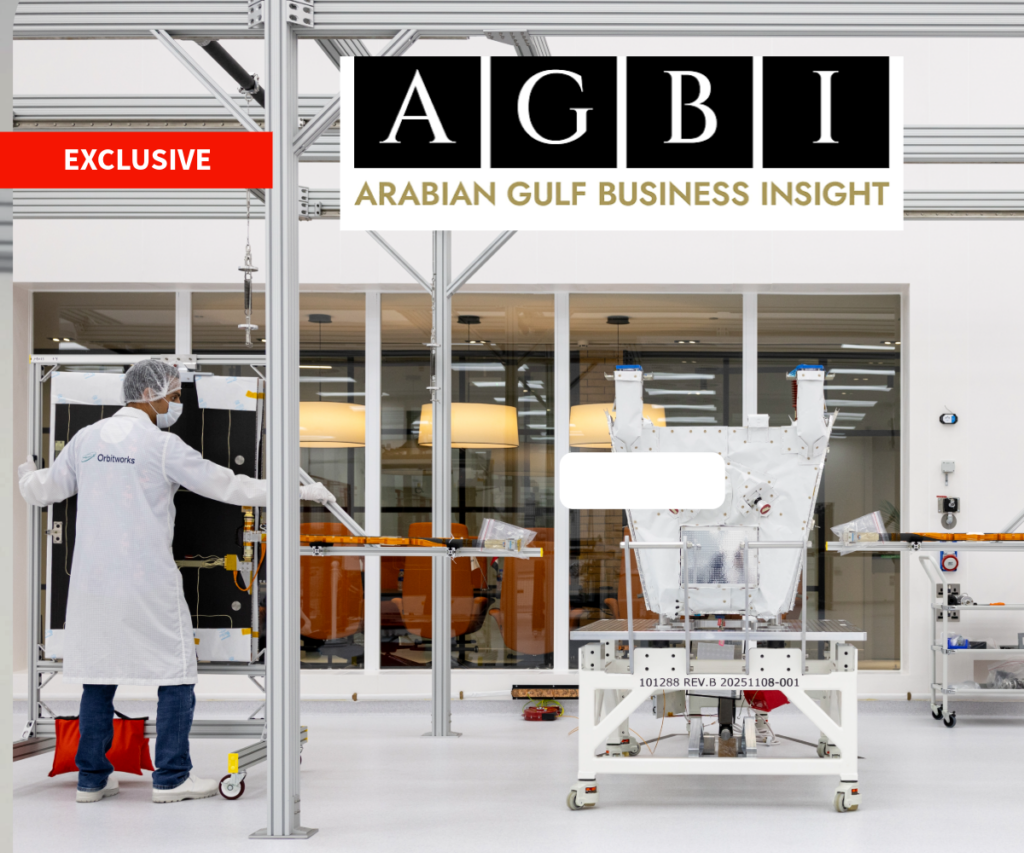
Orbitworks, a two-year-old satellite manufacturer in the UAE, is preparing for its first launch in the autumn just as the global space industry experiences a “pivotal” moment, CEO Hamdullah Mohib told AGBI.
Technological and geopolitical developments are bolstering the commercial and strategic appeal of space, and Orbitworks finds itself somewhere between the Starlink-studded record-breaking listing of Elon Musk’s SpaceX and the war in the Middle East.
The company has ambitions to play in the big leagues and the challenge of developing an entire regional supply chain from scratch, Mohib said.
“It is all triggered by the fact that space is becoming cheaper and more accessible for more and more nations and companies,” he said.
The industry is ripe for what Mohib calls Apple-like democratisation. Powerful sensors and ever-more versatile satellites will increasingly generate applications “far exceeding what we can even imagine today”, bringing space to new sectors.
“What I look at when I think of Orbitworks’ growth is: how do we [enable our customers] the way that the App Store did for app developers?”
The defence sector remains space’s anchor customer, Mohib said.
The US-Israeli war with Iran, which ensnared the UAE in a barrage of Iranian drones and missiles, has deepened Emirati authorities’ interest in sovereign space capabilities to secure uninterrupted access to strategic data.
“But we always had the ambition to bring satellites, and data from satellites, to every business there is,” Mohib said.
Mining, oil and gas, insurance, urban planning, agriculture, shipping and even international development are among the sectors he points to as existing use cases.
“The private equity industry uses satellites to measure traffic into malls so they can see if they are really as footfall-heavy as they claim,” he said.
Mohib is from Afghanistan and served as deputy chief of staff to then-president Ashraf Ghani, ambassador to Washington and national-security adviser. He referred to the ghost schools scattered through rural Afghanistan that were paid for by the US government but that nobody attended because they were in unsafe areas.
“One of our first customers is the Abu Dhabi Fund for Development,” he said. ADFD plans to use Orbitworks satellites to monitor projects across hard-to-reach regions of Africa and South America.
“This is happening today,” he said. “As these thermal sensors get better and the hyperspectral resolutions improve, we will see even more usage.”
Satellite integrator
Orbitworks is a joint venture between Abu Dhabi-based investment company Marlan Space, which Mohib also heads, and San Francisco-based space infrastructure company Loft Orbital.
Marlan is backed by the Royal Group, the Abu Dhabi royals’ family office chaired by Sheikh Tahnoon bin Zayed Al Nahyan, the UAE’s national-security adviser.
Mohib calls Orbitworks a “satellite integrator” that engineers, makes and tests satellites, and works with customers on bespoke designs or by leasing fittings for their components.
The company is building its Altair constellation of 10 AI-supported low-Earth-orbit satellites out of its 10-month-old factory in Abu Dhabi.
It counts the Abu Dhabi Maritime Academy, Emirati defence conglomerate Edge Group, and France’s space agency among other early clients.
“More importantly, we’re gearing up for our first launch,” Mohib said.
The launch is scheduled for October in California, and will be handled by SpaceX, a decision Mohib described as strictly commercial, since Musk’s company is the cheapest and most readily available option.
Four more satellites are expected to follow in the first quarter of next year, and Altair’s remaining five by the middle of 2027.
Further reading:
- Qatar to fund joint satellite project with Turkey
- New UAE space company to develop 50 satellites per year
- UAE space programme at private sector ‘tipping point’
Orbitworks is the first company of its kind in the Middle East, apart from ad-hoc research efforts, Mohib said.
It is part of a growing space industry in the UAE that also encompasses Space42, backed by the Gulf state’s AI developer G42 and sovereign wealth fund Mubadala, and the Mohammed bin Rashid Space Centre in Dubai, a scientific lab and incubator of the UAE national space programme.
“The closest satellite manufacturers to us are in China and in a nascent industry that’s popping up in India,” he said.
Importing overseas talent or training domestic workers, attracting capital and customers and overcoming the lack of a regional supply chain are among the biggest hurdles Orbitworks faces in its push to expand.
“There are a thousand components that go into these satellites, but there is no space-qualified component manufacturer here because there had never been a need for it, there was no company like us to buy from them,” Mohib said.